Artificial intelligence and technology in art for a sustainable and creative approach to fashion and furniture design
Institution: Liceo Chierici – Italy
The integration of Artificial Intelligence into the Learning Sequence represents an opportunity to stimulate creativity and the capacity for reflection and design of students, reinforcing active and interdisciplinary learning. AI allows exploring innovative approaches to creating, researching, prototyping and evaluating, fostering a dynamic dialogue between human skills and intelligent tools.
In an educational context increasingly connected to the challenges of the future, the conscious and critical use of AI promotes sustainable innovation and digital citizenship. Its adoption makes it possible to personalize the training experience and promote conceptual thinking. In this context, AI becomes an educational ally to make the learning sequence more effective, inclusive and oriented towards the professional world. . offer for teaching.
The activity was of a practical nature with a reference framework, examples and some exercises and is associated with the Artforward competition with Confindustria and the Order of Architects. Teachers also test teaching practices using digital tools such as the tracker and the digital passport, without losing sight of creativity and mastery of critical thinking.
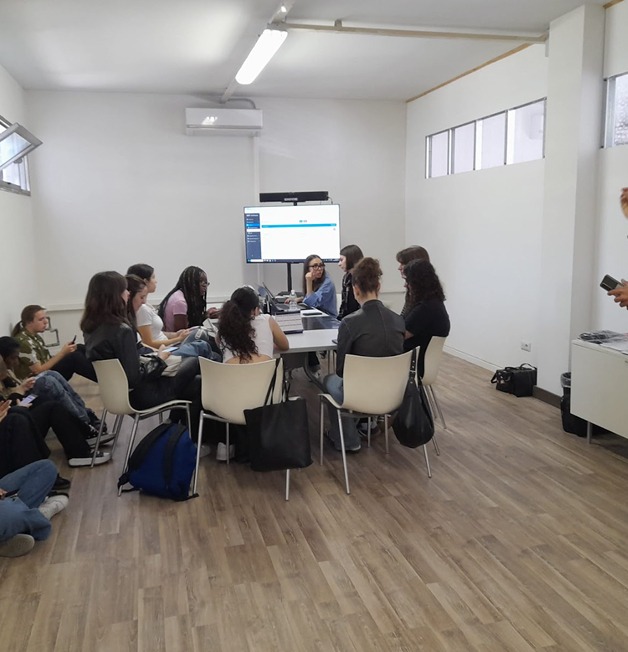
In an educational context increasingly connected to the challenges of the future, the conscious and critical use of AI promotes sustainable innovation and digital citizenship.
Didactic and teaching skills to be able to guide students in the responsible and methodical use of AI.
Know how to use AI to personalize learning and stimulate students’ creativity and critical thinking. The overall goal is for AI to be seen and used as a “co-creator” or “idea accelerator” that does not diminish the creative authority of humans, but enhances their capacities for exploration, experimentation and complex problem solving in the field of design.
The future is now: sustainable design in fashion
EcoTextil S.p.A.” (Produzione Tessile Sostenibile)
Description of practical phases and tasks.
1. Analysis of industrial waste.
2. Interdisciplinary brainstorming (fashion/architecture).
3. Prototyping and testing.
4. Final presentation.
First material approach: the students observed the material made available by the partner companies and chose, among the different pieces, those which interested them the most; . research (using AI) the characteristics of fabric scraps and analyze fashion trends, then create a mood board.
Traditional design process: During the summer vacation, the students designed a pattern inspired by informal art for the creation of a print (digital printing with plotter) on a piece of cotton muslin fabric (dimensions 50 x 150 . cm).
Second material approach: Using the coupon and the different scraps of fabric, the students designed a garment by assembling these pieces into patchwork.
Raising awareness among the school community and developing concrete design skills in the ecological sector.
Description of the product or service produced and its impact.
a capsule collection of 10 “regenerated” garments and the project of developing a window display with recycled materials for the high school.
Carpi Fashion System, Fondazione Democenter-Sipe – Centro Qualità Tessile (Textile Quality Center) is an approved research and analysis laboratory focusing on chemical and mechanical testing in the textile and personal protective equipment sectors.
Students were required to understand the concept and purpose of the Digital Product Passport (DPP), explore its role in promoting transparency and sustainability in fashion, and gain hands-on experience creating and uploading fictional fashion product data using DPP. software.
Students were required to understand the concept and purpose of the Digital Product Passport (DPP), explore its role in promoting transparency and sustainability in fashion, and gain hands-on experience creating and uploading fictional fashion product data using DPP. software.
Digital Product Passport (DPP): students discovered the purpose and functions of the DPP, including its role in ensuring product transparency, sustainability and supply chain traceability, both within their team and with external partners.
Ri-Uso Project: regional project led by CQT (Quality Control and . Traceability), which demonstrates how DPP, combined with eco-design tools, can drive circularity and help fashion SMEs comply with evolving sustainability regulations.
Hands-on activity: Students practiced entering fictitious fashion product data into the DPP software, simulating the entire process from designing a product to selecting suppliers and defining the . end customer.
The students participated in a practical project structured in several phases. First, they conceptualized a fictional fashion product, choosing materials, suppliers and target customers.
Then, under the supervision of a tutor, they used the DPP software to enter and manage product data, following a step-by-step procedure demonstrated by the CQT. Through this activity, students were not only able to practice using the digital product passport, but also understood how it is applied within a fashion company, including the roles and responsibilities of different departments in capturing and managing product information.
At the end of the activity, the students successfully entered their fictitious fashion products into the DPP platform, so that their fictitious company “Chierici” is now full of traceable fashion items.
The activity went beyond traditional teaching thanks to a digital and practical approach. After an online session introducing the Digital Product Passport (DPP) and demonstrating how the software works, the high school students visited QualitàTessile headquarters to experiment directly by uploading data on fictitious fashion products using dedicated accounts on the DPP platform.
Tool sheet:
Photo related to the visit of Carpi companies Practical sheet: x
VISIONART:
Using recycled and local materials